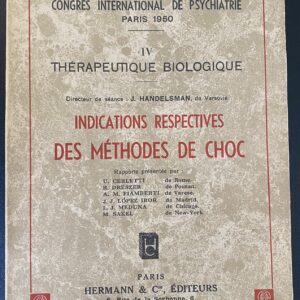


Handelsman, J. (1950) Congrès International de Psychiatrie, Paris 1950. IV. Thérapeutique biologique. Indications respectives des méthodes de choc. ( Actualités scientifiques et industrielles 1099).
Rating: ♥♥♥ (Very good)
Very good paperback, original cover. Shelf worn and gildede but has all pages and leaves present, no tears in paper or spine. Exlib.
 J. Handelsman’s 1950 publication represents a significant contribution to mid‑20th‑century clinical psychiatry, capturing a period when the field was rapidly evolving in response to new biological, psychological, and social theories. His work reflects the transitional nature of psychiatric practice in the post‑war era, combining classical descriptive methods with emerging scientific approaches.
The book provides a detailed examination of psychiatric syndromes as they were understood in 1950, including psychoses, neuroses, personality disturbances, and affective disorders. Handelsman places strong emphasis on clinical observation, case histories, and the careful differentiation of symptom patterns — a hallmark of descriptive psychiatry before the widespread adoption of standardized diagnostic systems.
A notable aspect of Handelsman’s work is his attention to the interplay between psychological conflict, environmental stressors, and constitutional factors. He discusses how heredity, trauma, social conditions, and personality structure contribute to the development of mental illness. This integrative perspective reflects the intellectual climate of the time, when psychiatry was beginning to incorporate insights from psychoanalysis, neurology, and early biological research.
The book also addresses therapeutic approaches available in the mid‑20th century, including psychotherapy, occupational therapy, somatic treatments, and early biological interventions. Handelsman’s writing captures the moment just before the psychopharmacological revolution, making this volume an important historical document for understanding psychiatric practice on the threshold of major scientific change.
Today, Handelsman’s 1950 work is valuable for historians of psychiatry, researchers studying diagnostic evolution, and collectors interested in the development of clinical practice during a pivotal period in mental health history.
Collector’s Note
Handelsman’s contributions to mid‑century psychiatry are increasingly appreciated by collectors and scholars. This 1950 volume offers a rich snapshot of clinical thinking before the rise of modern diagnostic systems and psychopharmacology. A strong addition to any collection focused on 20th‑century psychiatric literature, clinical history, or the evolution of psychopathology.
Keywords
- Handelsman psychiatry
- mid‑20th‑century psychiatric textbook
- history of psychopathology
- clinical psychiatry 1950
- descriptive psychiatry
- evolution of psychiatric diagnosis
- post‑war mental health literature
See also