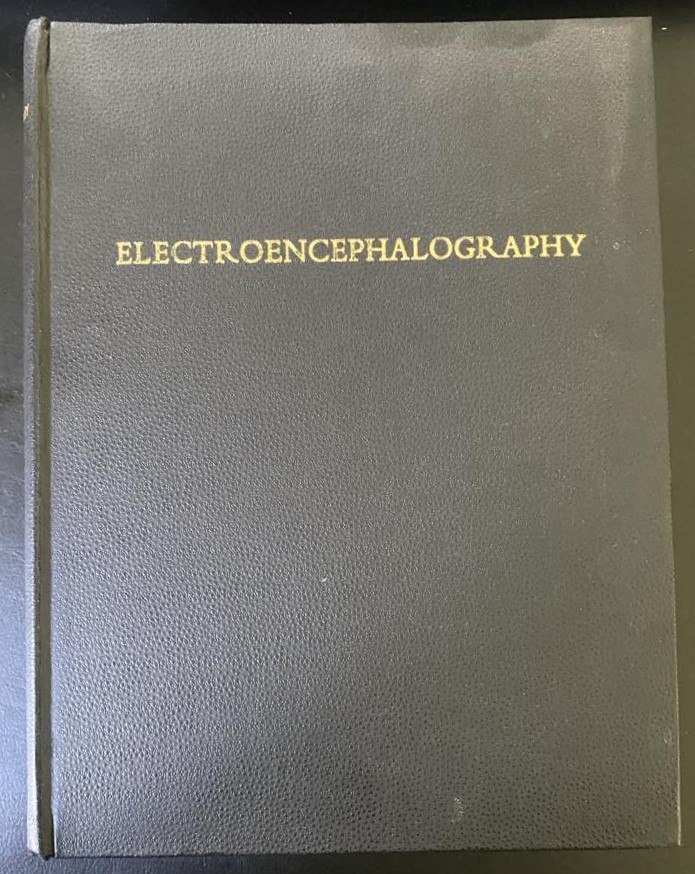


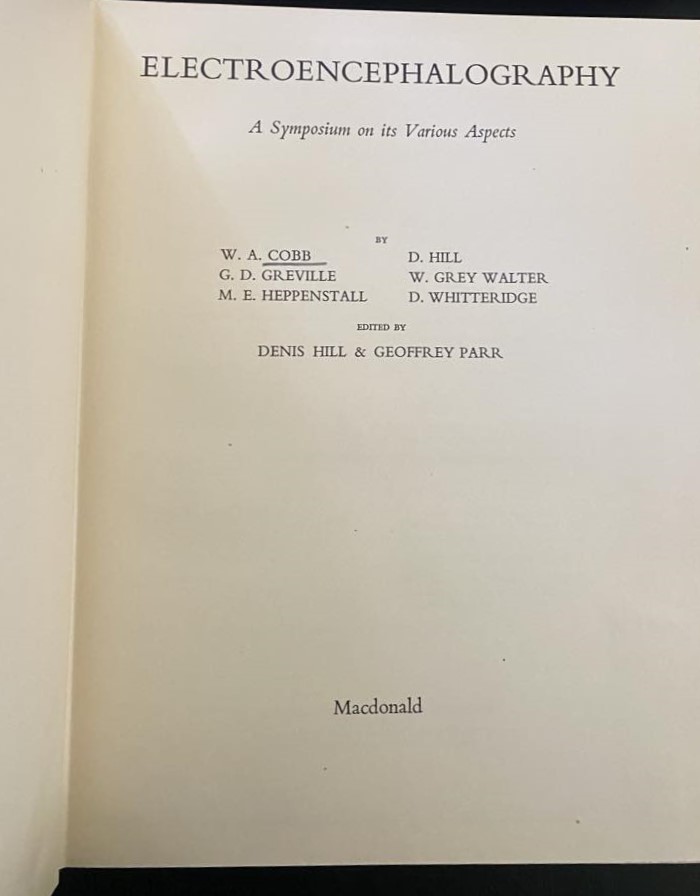
COBB (W. A.), HILL (D.), GREY WALTER (W.) etc. (1950) Electroencephalography. A Symposium on Its Various Aspects
Rating: ♥♥♥♥ (Fine)
Fine Book, No dustcover has all pages and leaves present, no tears on either or paper. Exlib.
 Sir Denis Hill (d. 1979), an eminent figure in psychiatry, was born and raised in Orleton, Herefordshire, with a lineage tracing back to Lieutenant-Colonel J.A. Hill. Educated at Shrewsbury School and later at St Thomas’s Hospital Medical School, his early fascination with electronics and its applications in medicine laid the foundation for his lifelong contributions to psychiatry.
During his tenure as house physician to Russell Brain at Maida Vale Hospital in 1936, Hill encountered Grey Walter’s pioneering EEG (electroencephalogram), which sparked his interest in its potential applications in psychiatry and epilepsy research. Throughout World War II, he played a pivotal role in establishing one of the first EEG laboratories, forging close ties with the armed forces’ medical services, and championing the integration of electroencephalography into neuropsychiatric investigations.
Hill’s prolific writings and research during this period significantly advanced the understanding of temporal lobe epilepsy and psychopathy, earning him widespread recognition within the medical community. His expertise in forensic psychiatry led to influential contributions to government committees, shaping policies related to mentally abnormal offenders and therapeutic interventions.
As a trailblazer in medical education, Hill advocated for the inclusion of psychiatry in undergraduate curricula, serving as a driving force behind its establishment at the Middlesex undergraduate school of London University. Later, he assumed the postgraduate chair at the Institute of Psychiatry, where he continued to promote psychotherapy as an academic and clinical discipline until his retirement in 1979.
Hill’s commitment to the medical profession extended beyond academia, as evidenced by his roles in professional bodies such as the General Medical Council, where he contributed to the development of health procedures related to fitness to practice.
Throughout his career, Hill’s humility, dedication, and scholarly prowess earned him admiration and respect. Despite shying away from prominent leadership roles, his impact on psychiatry and medical education remains enduring, characterized by his tireless pursuit of excellence and his unwavering commitment to advancing the field for future generations.