



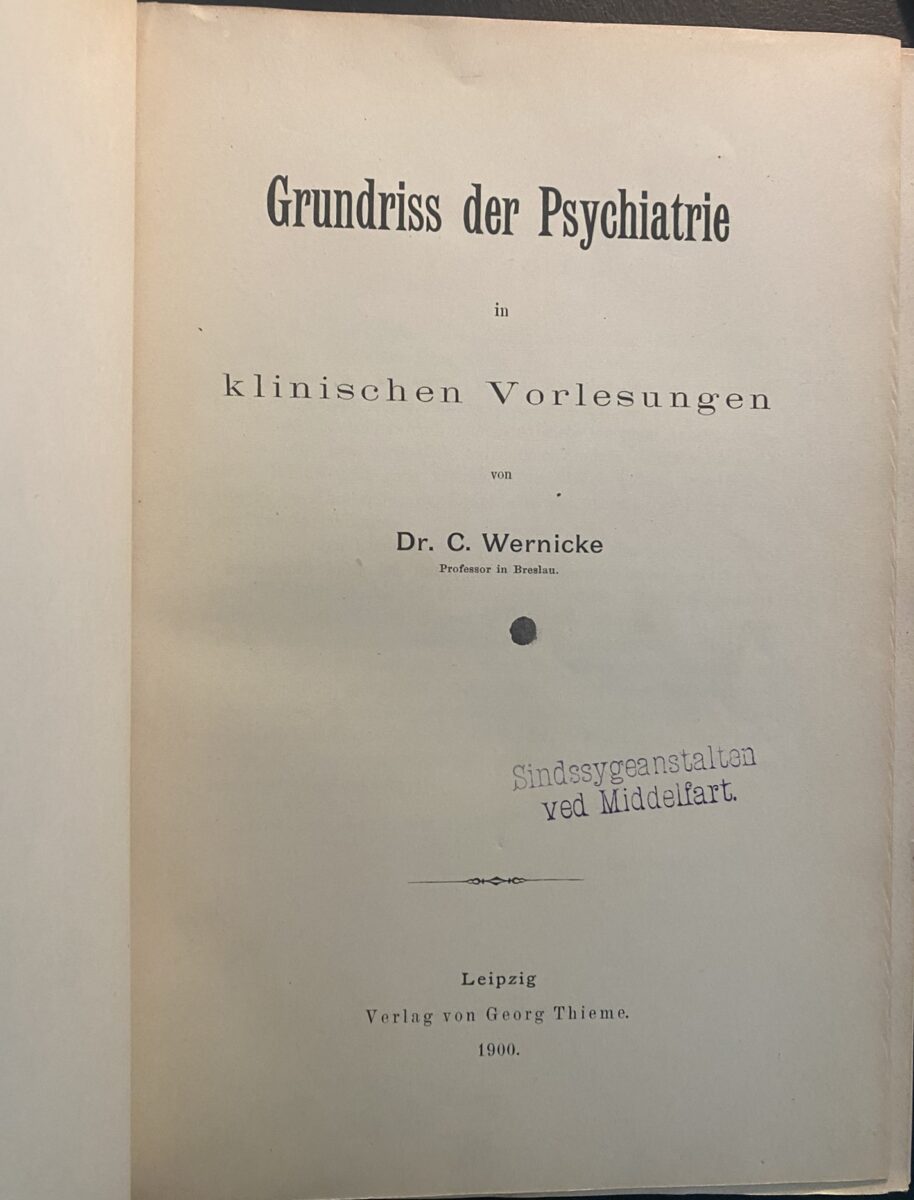
Wernicke, C. (1900) Grundriss der Psychiatrie in klinischen Vorlesungen
Rating: ♥♥ (Good)
The book is shelve worn, spine has glued at some point. Mark from tape can be found on the cover. Pages are darkened, binding is lose but the book still holds its pages. Pages and leaves present, no tears in paper or cover. Exlib.
 Carl Wernicke, a German neurologist and psychiatrist, published *Grundriss der Psychiatrie in klinischen Vorlesungen* in 1900. This book outlined key psychiatric concepts through clinical lectures. Wernicke aimed to integrate neurology and psychiatry, highlighting the role of brain function in mental disorders.
By 1900, psychiatry was becoming more scientific, with increasing focus on brain structure and function. Wernicke, known for his discovery of Wernicke’s area (linked to language comprehension), combined his neurological expertise with psychiatric theory. His goal was to provide a clear, clinical framework for understanding mental illness.
- Wernicke emphasized the connection between brain pathology and mental illness. He argued that brain lesions and dysfunctions caused specific psychiatric symptoms.
- The book focused on teaching psychiatry through clinical observation. Wernicke used real cases to explain mental disorders, making his lectures practical and accessible for students and doctors.
- Wernicke classified psychiatric illnesses based on neurological causes. He categorized disorders by their effects on different parts of the brain and how they altered behavior.
- Wernicke believed that psychiatry and neurology were inseparable. His work laid the foundation for neuropsychiatry, showing how brain injuries and dysfunctions could explain mental symptoms.
Grundriss der Psychiatrie in klinischen Vorlesungen became an influential text in psychiatry. Wernicke’s emphasis on the brain’s role in mental illness helped bridge neurology and psychiatry. His clinical approach and classification system shaped modern psychiatric diagnostics and the study of brain-behavior relationships.