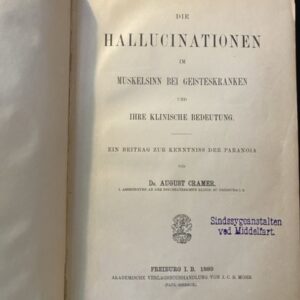


Freud, Sigmund (1969) Gesammelte Werke. Chronologisch geordnet Bd. 4 Zur Psychopathologie des Alltagslebens
♥♥♥♥ (Fine) : A fine book no defects to the book, jacket, or pages. Gildede pages and shelf worn. Exlib.
 Early Life
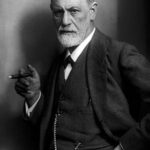
Sigmund Freud was born on May 6, 1856, in Freiberg, Moravia (now Czech Republic). He was the eldest of eight children in a Jewish family. His father, Jakob, was a wool merchant. His mother, Amalia, was Jakob’s third wife. In 1860, the family moved to Vienna, Austria. Freud excelled in school and showed an early interest in science and literature.
Freud studied medicine at the University of Vienna in 1873. He earned his medical degree in 1881. He worked in neurophysiology under Ernst Brücke. In 1885, Freud studied hypnosis in Paris with Jean-Martin Charcot. This experience shaped his interest in mental illness. Freud opened a private practice in Vienna in 1886, focusing on nervous disorders. He married Martha Bernays that year and had six children.
Development of Psychoanalysis
Freud collaborated with Josef Breuer in the 1890s. Together, they treated a patient known as “Anna O.” and explored hysteria. Freud developed free association, letting patients speak openly to uncover repressed thoughts. In 1899, he published The Interpretation of Dreams, introducing his theory of the unconscious. He described the mind as divided into the id, ego, and superego.
Major Works and Theories
Freud wrote many influential books, including:
- The Interpretation of Dreams (1899): Explained dream analysis.
- Three Essays on the Theory of Sexuality (1905): Introduced psychosexual development stages.
- Civilization and Its Discontents (1930): Discussed conflicts between individual desires and society.
Freud’s ideas, such as the Oedipus complex, sparked debate. Some praised his work, while others criticized it.
Later Life and Legacy
Freud developed jaw cancer in the 1920s. Despite illness, he continued working. In 1938, Nazis annexed Austria, forcing Freud to flee to London. He died on September 23, 1939, at age 83. Freud’s work transformed psychology. His theories still influence therapy, literature, and culture today.